Tuesday, 14 May 2013

PowerPuff Girls


The Powerpuff Girls is an American animated television series created by Animator Craig McCracken and produced by Cartoon Network Studios for Cartoon Network. The show centers on Blossom, Bubbles, and Buttercup, three kindergarten-aged girls with superpowers, as well as their ''Father'', the brainy scientist Professor Utonium, who all live in the Fictional City of Townsville, USA. The girls are frequently called upon by the town's childlike mayor to help fight nearby criminals using their powers.

The Powerpuff Girls revolves around the adventures of Blossom, Bubbles, and Buttercup. Each of the girls has a color: Blossom is pink, Bubbles is blue, and Buttercup is green. The plot of a typical episode is some humorous variation of standard superhero and tokusatsu fare, with the girls using their powers to defend their town from villains and giant monsters. In addition, the girls have to deal with normal issues young children face, such as sibling rivalries, loose teeth, personal hygiene, going to school, bed wetting, or dependence on a security blanket. Episodes often contain more or less hidden references to older pop culture (especially noticeable in the episode "Meet the Beat Alls," having been an homage to the Beatles). The cartoon always tries to keep different ideas within each episode with some small tributes and parodies thrown in.
The setting of the show is mainly the city of Townsville, USA. Townsville is depicted as a major American city, with a cityscape consisting of several major skyscrapers. In his review of The Powerpuff Girls Movie, movie critic Bob Longino of The Atlanta Journal-Constitution said that, "the intricate drawings emanate 1950s futuristic pizazz like a David Hockney scenescape," and that the show is "one of the few American creations that is both gleeful pop culture and exquisite high art.
-------------------------------------------------------------------------------------------------------------------------------------------------------------------
The Powerpuff Girls series debut on November 18, 1998, was the highest rated premiere in Cartoon Network's history at the time. The series consistently scored the highest rating each week for the network across a wide range of demographics—from young children to adults. In October 2000, Cartoon Network credited The Powerpuff Girls for its Friday night prime time ratings win among cable networks. By the end of 2000, merchandising based on The Powerpuff Girls encompassed a whole variety of products, including T-shirts, toys, video games, lunchboxes, and dish ware. Concerning The Powerpuff Girls success, Craig McCracken has stated, "I thought it would get on Cartoon Network and college kids would watch it and there would be a few random T-shirts out there in the rave scene or in record shops. But I had no idea that it would take off to this extent." The show's last original run episode was on March 25, 2005, in all six seasons were made.
On January 28, 2013, it was announced that a new CGI special starring the girls will premiere later in the year. The special will feature Ringo Starr of The Beatles singing a new original song I Wish I Was A Powerpuff Girl and voicing a new character named Fibonacci Sequins. The special will be directed by Dave Smith, who directed episodes for the series in the past, with the original cast members returning to reprise their roles.

Tuesday, 7 May 2013

Tom and Jerry


                                           Tom and Jerry


Tom and Jerry is a series of theatrical animated cartoon films created by William Hanna and Joseph Barbera for Metro-Goldwyn-Mayer, centering on a rivalry between a cat (Tom) and a mouse (Jerry) whose chases involved comic violence. 
-------------------------------------------------------------------------------------------------------------------------------------------------------------------
A longtime television staple, Tom and Jerry has a worldwide audience and has been recognized as one of the most famous and longest-lived rivalries in American cinema. In 2000, Time magazine named Tom and Jerry one of the greatest television shows of all time.
The series features comedic fights between an iconic set of enemies, a house cat and mouse. The plots of each short usually center on Tom's numerous attempts to capture Jerry and the mayhem and destruction that ensues. Tom rarely succeeds in catching Jerry, mainly because of Jerry's cleverness, cunning abilities, and luck. Despite this, there are also several instances within the cartoons where they display genuine friendship and concern for each other's well-being. Other times, the pair set aside their rivalry in order to pursue a common goal, such as when a baby escaped the watch of a negligent teen babysitter, causing Tom and Jerry to pursue the baby and keep it away from danger.
The cartoons are infamous for some of the most violent cartoon gags ever devised in theatrical animation, such as Jerry slicing Tom in half, shutting his head in a window or a door, Tom using everything from axes, firearms, explosives, traps and poison to try to murder Jerry, Jerry stuffing Tom's tail in a waffle iron and a mangle, kicking him into a refrigerator, plugging his tail into an electric socket, pounding him with a mace, club or mallet, causing a tree or an electric pole to drive him into the ground, sticking matches into his feet and lighting them, tying him to a firework and setting it off, and so on. Because of this, Tom and Jerry has often been criticized as excessively violent. Despite the frequent violence, there is no blood or gore in any scene.


Wednesday, 24 April 2013

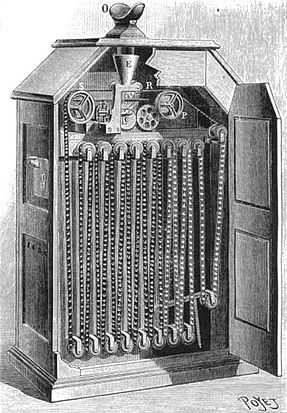
Kinetiscope

Kinatoscope was created by Thomas Edison
In early 1889, he finally gave a name to his planned invention in a second claim: kinetoscope, from the Greek
words quint means “movement” and scoops means “to view”
William Dickson, Edison's assistant and one of his most talented men. His task was to develop the kinatiscope. Because of this, many scholars and historians largely credited Dickson despite Edison taking the full credit. Edison started using them for testing during the kinetoscope’s development. Eastman Company eventually started producing its own celluloid films, which Dickson soon began purchasing by bulk. Working under this new direction, Dickson, along with a new assistant, started creating a device with a horizontal-feed system for exposing film strips.
The kinetoscope was born. The prototype, which was also a camera aside from a peep-hole viewer, was unveiled on May 20, 1891. It used 18mm wide films, which, according to author David Robinson
The final product was completed in 1892, sporting a minor change: the horizontal-feed mechanism was replaced with a vertical one. It was formally introduced to the public on May 9, 1893 at the Brooklyn Institute of Arts and Sciences. To watch a clip of moving images, the viewer would peek into a peep-hole with magnifying lenses on top of the cabinet.

Wednesday, 6 February 2013

Phase Two (2.2)

The Zoetrope was invented by William Horner on 1834. He made his design of Zoetrope and he owned a name for his Zoetrope. It called 'Daedalum' (The Wheel of the Devil).